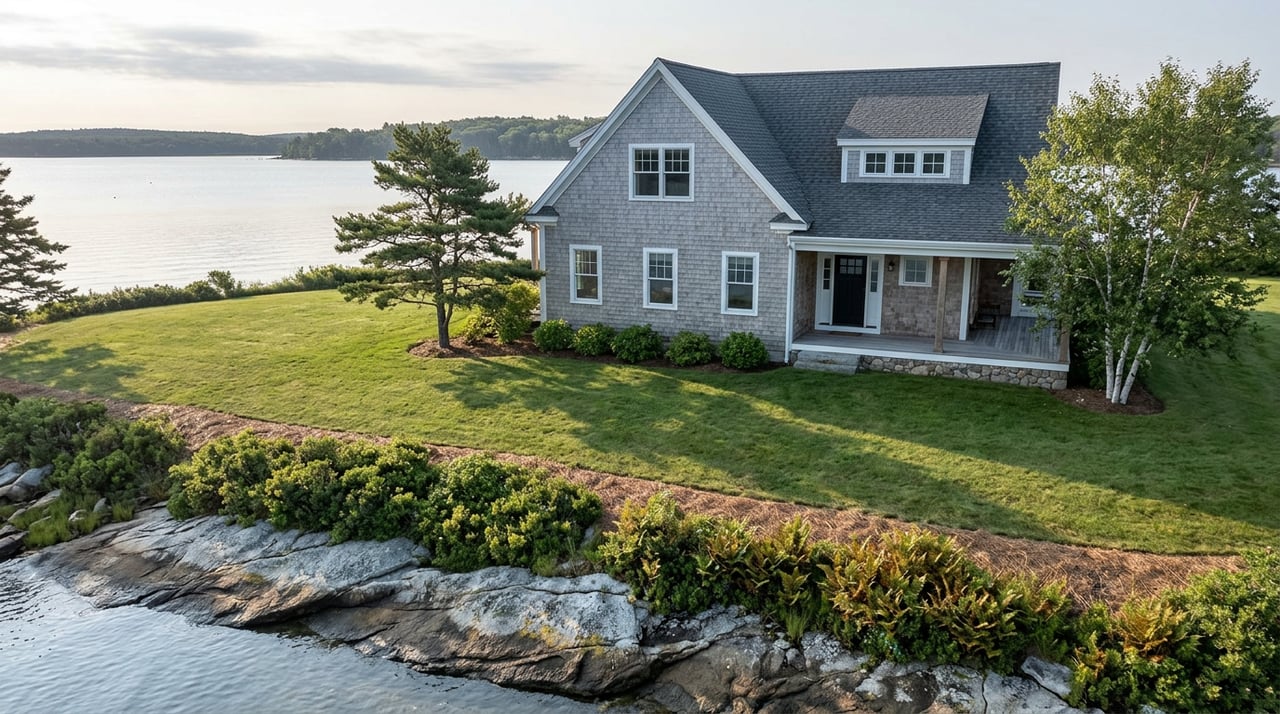
Two properties on Sebago Lake in Raymond looked completely different by the fall of 2021. At those properties, a natural shoreline of tall trees and rocky bank had been replaced with more than 400 linear feet of riprap, the loose rock used to armor a shore against erosion. No permits had been pulled for any of it. By the time the town, the state, and the property owner finished sorting it out, Raymond had a settlement worth $650,000, a new state law, and a disclosure form that now asks Raymond sellers to put more of their property's history in writing than most of them realize.
If you own a camp or a year-round home anywhere near Sebago Lake, Panther Pond, or Crescent Lake and you're thinking about selling, the new disclosure rules mean your conversation with your agent just got longer. Here's what changed, and what it actually means for you.
Fifteen Violations, Nearly Two and a Half Years, One New Law
The town of Raymond first flagged the work at the two properties in the fall of 2021. By December of that year, the town had cited the property owner and the owner's holding company for 15 separate violations of Raymond's shoreland zoning ordinance and unpermitted construction. The Maine Department of Environmental Protection added its own citations for violations of the Natural Resources Protection Act.
What followed was nearly two and a half years of appeals, mediation, and legal wrangling that cost the town somewhere between $300,000 and $400,000 in legal fees alone. Contractors tied to the work, including Robert Durant of Casco, his firms Durant Excavating and Big Lake Marine, and Q-Team Tree Service of Naples, were named alongside the property owner in the eventual settlement. In April 2024, the parties agreed to a $650,000 payment to the town, on top of the cost of restoring the shoreline itself. Raymond's code enforcement officer, Chris Hanson, had been involved with the case from the start and helped see it through to resolution.
The restoration work is still tied to the calendar. Sebago Lake's water level drops 15 to 18 inches in the fall and winter, and much of the riprap removal and replanting at the two properties had to wait for that lower water window rather than happen during the summer season when the lake is busiest.
State Senator Tim Nangle, a Democrat whose district includes Raymond, introduced LD 2101, "An Act to Strengthen Shoreland Zoning Enforcement." Governor Janet Mills signed it into law on April 9, 2024. Among other things, it gave Raymond and other towns the ability to withhold future permits from property owners with unresolved violations and to place liens on the land itself to recover costs. It also required sellers of residential property in a shoreland zone to disclose known shoreland zoning violations to buyers.
What the Statute Actually Requires Now
LD 2101 opened the door, but it wasn't the last word. In 2025, the Legislature went further and wrote the disclosure requirement into specific language now codified in Title 33 of Maine statute. A seller of residential property in a shoreland zone must now disclose detailed information about five distinct categories tied to shoreland zoning:
| Category | What it covers |
|---|---|
| Notice of violation | Any notice issued by a municipal official or state agency |
| Pending enforcement action | Any enforcement matter still open |
| Litigation | Any lawsuit connected to the shoreland zoning issue |
| Court judgment | Any judgment entered against the property |
| Settlement or consent agreement | Any resolved case, including one that's fully closed |
That last category is the one that catches sellers off guard. A case that's already settled, restoration already completed, fine already paid, still has to show up on the disclosure form. The property owner's case is closed. If that property ever sells, the settlement history goes on paper anyway.
An earlier version of this idea, a bill called LD 413, would have required disclosure of even alleged violations that hadn't been substantiated. The Maine DEP testified against that language, pointing out that a mere complaint isn't the same as a confirmed violation and that removing the word "alleged" could unfairly follow a property that never actually did anything wrong. The law that passed struck a narrower balance: formal notices, open enforcement, litigation, judgments, and settlements, not every complaint a neighbor ever filed.
Why This Matters More in Raymond Than Most Towns
Raymond sits on three bodies of water big enough to qualify as "great ponds" under Maine law. The Maine Department of Environmental Protection explains that a 250-foot shoreland zone extends around great ponds including Sebago Lake, Panther Pond, and Crescent Lake. That zone comes with its own construction rules, and a lot of camps on these lakes predate those rules by decades.
According to Cornell Law School's copy of Maine's shoreland zoning regulations, any portion of a building within 25 feet of the normal high-water line cannot be expanded at all, even if the expansion wouldn't make the setback problem any worse. Between 25 and 75 feet, an owner can typically expand up to whichever is larger: 1,000 square feet or 30 percent more than the footprint that existed on January 1, 1989.
None of that is new law. What's new is that a property's history of running afoul of those rules, or resolving a dispute over them, now has to be spelled out before a buyer signs anything. For a lake town where informal shoreline work by a previous owner, a contractor doing a favor, or a well-meaning DIY project is common, "the way it's always been" and "what's legally documented" aren't always the same thing.
The Timing Detail Sellers Miss
If your property has any history with Raymond's code enforcement office, whether it's a notice from years ago or something still being worked through, the disclosure obligation doesn't wait for a convenient season. Many shoreland fixes and permitted work can only happen once the lake drops in the fall, which means a violation flagged in July might not be fully resolved until the following spring. If you're planning to list in the busy spring or summer market, that gap between "we're addressing it" and "it's resolved" is exactly the kind of thing a buyer's attorney will ask about at the table, not before.
The practical move is to check in with Raymond's code enforcement office well before you list, not after an offer arrives. Ask directly whether any notice, past or present, is tied to your parcel. If your camp has ever had shoreline work done, whether that was clearing, riprap, a dock, or an addition, pull whatever permit history exists so you're not reconstructing it under deadline pressure once a buyer is already in the picture.
A Few Questions Sellers Ask Directly
Does this only apply to violations that are still open? No. The current statute specifically includes settlements and consent agreements, meaning a fully resolved case still needs to be disclosed. A closed file is not the same as a clean slate on the disclosure form.
My camp has never been expanded, just maintained over the years. Am I affected? Probably not, as long as no notice of violation or enforcement action was ever issued.
Where do I find out if there's anything on record for my property? Raymond's code enforcement office is the first call, since shoreland zoning is enforced at the municipal level. For general background on how the state's shoreland zoning rules work, the Maine Department of Environmental Protection maintains a public overview of the Mandatory Shoreland Zoning Act.
The Takeaway for Anyone Selling a Raymond Lake Property
The case involving the two properties cost one property owner $650,000 and cost the town years of legal fees, but the part that outlasts both is the paperwork. Every seller of residential property in a shoreland zone on Sebago Lake, Panther Pond, or Crescent Lake now has a legal obligation to disclose known shoreland zoning violations to buyers before a buyer commits. Getting ahead of that conversation, rather than being surprised by it mid-contract, is the difference between a clean closing and a renegotiation.
If you're weighing a sale on Raymond's lakes and want a clear read on what your property's history actually requires you to disclose, Ashley Fearon and A Team Realty can walk through it with you. Book your free seller strategy consultation and get the full picture before you list.
This article is general information, not legal, tax or financial advice. Consult a qualified professional about your situation.